Garment exports grow 15.38pc in July-April
The exports of readymade garments from Bangladesh increased by 15.38 percent to US$ 19.97 billion during the first ten months of the ongoing fiscal year 2013-14, as against exports of $17.307 billion made during the corresponding period of the previous fiscal, as per the latest data released by the Export Promotion Bureau (EPB).
Segment-wise, woven apparel exports grew by 13.91 percent year-on-year to $10.166 billion during July-April 2013-14 period, whereas knitwear exports soared by 16.96 percent to $9.803 billion.
Knitwear and woven garments together accounted for 81 percent of total $24.654 billion exports made by the South Asian nation during the ten-month period beginning July 1, 2014.
![]()
Trade gap narrows in July-Jan on poor import growth

The country’s trade deficit narrowed by 35.01 per cent in the first seven months of the current financial year compared with that of the same period of the FY 2012-13 due to a rise in exports against a poor growth in imports.
According to the latest BB data, the deficit decreased to $2.78 billion in July-January of the FY14 from $4.28 billion in the same period of the FY13.
 Experts and BB officials said that the narrowed trade gap would not put much positive impact on the country’s macro-economic situation as the imports ...
Experts and BB officials said that the narrowed trade gap would not put much positive impact on the country’s macro-economic situation as the imports ...
Taka to Dhaka keep declining

Cash remittances to Bangladesh from its global diaspora of migrant workers – the country’s second-largest source of foreign exchange behind the garment industry – continue to slide. The Bangladesh Bank, the country’s central bank, reported that in January, such remittances totaled $1.25 billion, a 5.8 percent decline from the year-earlier period, and the sixth consecutive month of falling inflows. From July 2013 to January 2014, the first seven months of the current fiscal year, remittances amounted to $8 billion, a 9 percent drop from the comparable year-ago period.
[caption id="attachment_4186" align="alignleft" width="300"]![]()

Trade deficit drops to $1.53b in H1
The country’s trade deficit decreased by 58.28 per cent in the first half of the current financial year compared with that of 34.13 per cent fall in the same period of the FY13 due to a rise in exports against negative growth in imports.
According to the latest BB data, the deficit narrowed to $1.53 billion in July-December of the FY14 from $3.67 billion in the corresponding period of the FY13, reports the New Age.
A BB official told New Age on Thursday that the trade deficit had declined significantly in the first half of the FY14 due to the political unrest over the general elections.

Foreign exchange regulation relaxed for industrial enterprises
Bangladesh Bank (BB) relaxed foreign exchange transactions rule for industrial entrepreneurs to help accelerate industry- driven growth.
The central bank in a circular on Sunday said industrial enterprises would get guarantee through authorized dealers (ADs) for borrowing from external sources. The enterprises, however, should have approval from the Board of Investment (BoI), BSS reports.
Earlier in a circular, the central bank advised all ADs to take prior approval from BB to furnish guarantees to or hold collaterals on-behalf of overseas bank branches or correspondents in respect of credit...
Earlier in a circular, the central bank advised all ADs to take prior approval from BB to furnish guarantees to or hold collaterals on-behalf of overseas bank branches or correspondents in respect of credit...
Labour market needed to expand amid fall in remittances
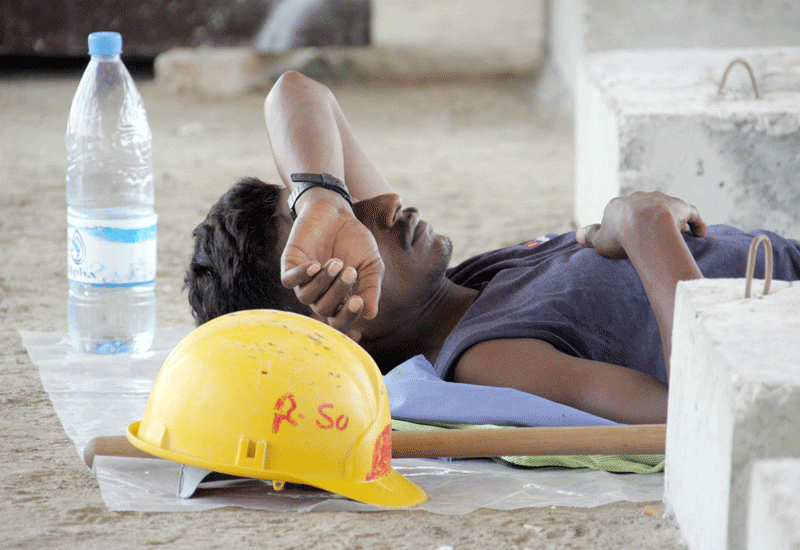
The inward flow of remittance is going down as the country is failing to send more workers abroad to traditional labour markets and explore new markets. The country’s remittance inflow dropped by nearly 3.0 per cent to $13.83 billion in 2013 from $14.17 billion in 2012.
In fact, the latest drop in remittance occurred in line with predictions by the economists. They say if Bangladesh cannot send new workers abroad, there will not be significant growth in remittances. The migrant workers are now sending money home as per their maximum capacities and have little capacity to increase the flow.
![]()