River otters to catch fish

In southwest Bangladesh, fishermen get help from unusual partners: river otters. For generations, fishermen have trained river otters to catch fish. But the rare tradition is fading away as rivers change and become more polluted, leaving fewer fish to catch.
On a long wooden boat, river otters squeal and squirm inside a large bamboo box. On this sunny autumn day in Narail District, fishermen guide the boat along the green waters of the Chitra River. When they open the box, six brown otters scramble out and dive into the river. They gleefully glide alongside the boat propelled by fishermen with long oars.

Master plan for efficiency in energy use

Sustainable and Renewable Energy Development Authority (SREDA) has initiated a move to formulate an Energy Efficiency and Conservation Master Plan (EECMP) to improve the overall efficiency of energy use in the country.
Official sources said SREDA has already outlined its focused areas of the energy efficiency and conservation where it will work with utmost importance, reports UNB.
 SREDA was recently created under a new Act to promote renewable energy and bring efficiency in the use of energy, particularly the power and natu...
 SREDA was recently created under a new Act to promote renewable energy and bring efficiency in the use of energy, particularly the power and natu...
Shelter Solution to address disaster risk

A workshop on Shelter Solution has exchanged views, expertise and experiences among the stakeholders to find out appropriate technologies and cost effective solutions to construct households, and install water and sanitation system in a disaster resilient and sustainable manner in country’s disaster prone areas.
It also emphasized on the collective efforts to step forward the technical suitability and quality of the shelter responses to the natural calamities.
In addition, review findings based on field visit to some disaster prone areas of Bangladesh and current p practices was also shared at the workshop.


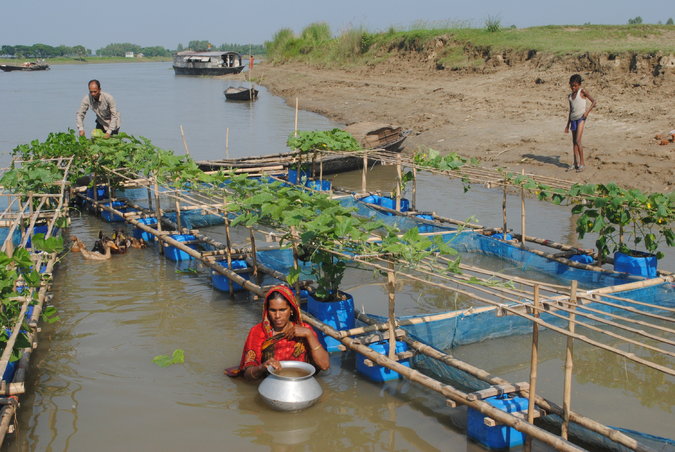
Floating gardens to prevent the effects of climate change

Each year the brown waters of the Gumani river swell during the summer monsoon, creeping over the surrounding fields to flood Charbhangura, a village of 2,500 people in the Pabna district of northwest Bangladesh.
From July to October the waters can rise at least 10 feet. The trunks of trees more than 30 feet away from the dry season riverbed show watermarks waist high. When the fields flood, the village’s farmers have no work.
“There is water all around,” said Hafiza Khatun, 25, a mother of two whose family income used to vanish for six months of the year when her farm laborer husband had nothing to do. “There was no happiness.”

3m residential solar systems now in Bangladesh

In order to achieve its energy 2021 energy target providing electricity access to all residents, the country is seeking to more than double electricity generation to 24 GW, 10% of which from renewables.
Bangladesh has installed more than 3.1 million systems since May with support from the World Bank and other development agencies.
Bangladesh’s Infrastructure Development Company Ltd (Idcol) last week marked the installation of 3 million residential solar systems in the country.
 According to Bangladeshi newspaper The Daily...
 According to Bangladeshi newspaper The Daily...
The answer lies in solar energy
Last week, Bangladesh suffered a nationwide blackout for around 12 hours. The country’s hospitals, airports, businesses and government offices were forced to use backup generators. The capital Dhaka resembled a ghost town as it plunged into darkness.
Unfortunately, blackouts in the South Asian country aren’t a rare occurrence. The country, which relies on a 400 MW (mega watt) power line from India to provide electricity for its people, has experienced many power outages in the past few years.
According to official estimates...
According to official estimates...