Showing resilience to internal and external crises, Bangladesh economy grew last year at an impressive rate, which was much above the global average, according to Bangladesh Bank (BB) annual report for 2012-13 released here today.The report, a flagship public of the central bank on economy, showed that the economy grew by 6.0 percent in 2013, much higher than the world economy advanced on average. “Using the 1995-96 base year the Bangladesh economy achieved GDP growth of 6.0 percent in FY13, and 6.2 percent using the 2005-06 base,” the report said.
The BB attributed the “solid economic growth rate” to the substantial remittance inflows and export activities.
According to the BB report, the global economy remained subdued a...
The country’s trade deficit decreased by 58.28 per cent in the first half of the current financial year compared with that of 34.13 per cent fall in the same period of the FY13 due to a rise in exports against negative growth in imports.
According to the latest BB data, the deficit narrowed to $1.53 billion in July-December of the FY14 from $3.67 billion in the corresponding period of the FY13, reports the New Age.
A BB official told New Age on Thursday that the trade deficit had declined significantly in the first half of the FY14 due to the political unrest over the general elections.

Bangladesh's rice production in the MY 2013-14 (May 2013 - April 2014) is expected to increase to around 34.59 million tons, up about 2% from around 33.82 million tons produced in the MY 2012-13 due to better yields and good weather, according to the USDA Post in Dhaka.

The USDA Post lowered its estimates for the Aus (planted in March/April and harvested in June/July) crop by 90,000 tons to 2.41 million tons as the yields were hurt by flash floods in northern ...
The country's foreign exchange reserves rose to a record $18.12 billion at the end of January from $18.07 billion a month earlier, the central bank said on Monday.

The higher reserves, which stem from a widening current-account surplus, are enough to cover six months of imports. At the end of January 2013, reserves totalled $13.1 billion.
Rising exports and a slowing of imports have helped build the reserves despite a drop in inward remittances as number of Bangladeshis going abroad to work in the Middle East has declined.
I...
Bangladesh Bank (BB) relaxed foreign exchange transactions rule for industrial entrepreneurs to help accelerate industry- driven growth.
The central bank in a circular on Sunday said industrial enterprises would get guarantee through authorized dealers (ADs) for borrowing from external sources. The enterprises, however, should have approval from the Board of Investment (BoI), BSS reports.

Earlier in a circular, the central bank advised all ADs to take prior approval from BB to furnish guarantees to or hold collaterals on-behalf of overseas bank branches or correspondents in respect of credit...
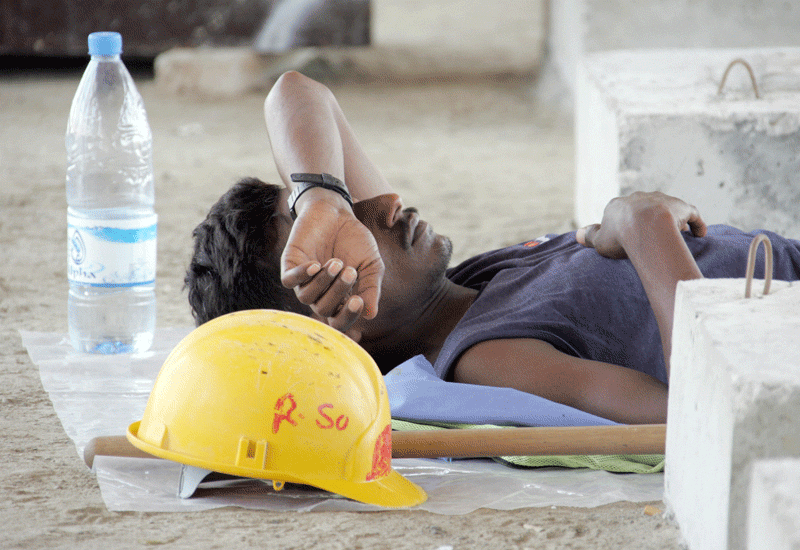
The inward flow of remittance is going down as the country is failing to send more workers abroad to traditional labour markets and explore new markets. The country’s remittance inflow dropped by nearly 3.0 per cent to $13.83 billion in 2013 from $14.17 billion in 2012.
In fact, the latest drop in remittance occurred in line with predictions by the economists. They say if Bangladesh cannot send new workers abroad, there will not be significant growth in remittances. The migrant workers are now sending money home as per their maximum capacities and have little capacity to increase the flow.
![]()