Development projects in Bangladesh supported by the International Fund for Agricultural Development (IFAD) are making substantial progress in helping reduce rural poverty by improving agricultural productivity. Technological innovations and microenterprise development are among the key factors highlighted by a new country programme evaluation that will be presented on Sunday.
The country programme’s target group includes people living in extreme and moderate poverty. Its targeting strategy starts by identifying geographic areas of poverty and then assessing household assets and needs – including food supply – in those areas. For example the haor areas in Sunamganj, and char areas in newly accreted land near sea in Noakhali, are remote and hard–to–reach inaccessible locations covered ...
Indian Prime Minister Narendra Modi’s ongoing visit to Bangladesh has generated a flurry of hope on both sides of the border.
Foreign minister AH Mahmud Ali feels that this visit is extremely significant where multifaceted relations between Bangladesh and India are concerned.
At a press conference in Delhi too, Indian foreign Secretary S Jaishankar said, this visit of Narendra Modi is a historic one in all senses. The land boundary agreement has opened new vistas of cooperation and goodwill.
The Indian prime minister is leading an 81-member delegation. The delegation includes West Bengal chief minister Mamata Banerjee, India’s national security advisor Ajit Duval and foreign secretary S Jaishankar.
However, prior to Modi’s visit it was made clear that the Teesta deal would n...
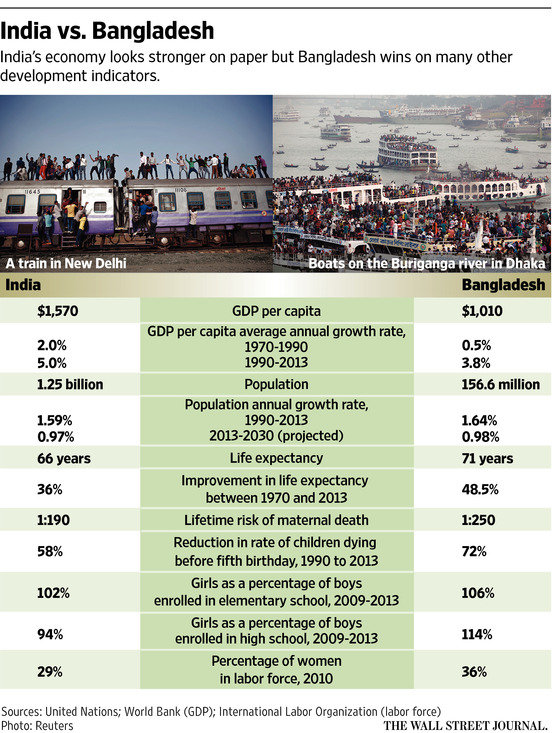
India is richer, in terms of per-capita economic output, than its smaller neighbor, Bangladesh, and a greater proportion of Indians are connected to the Internet and have cellphones.
But if you look more closely at other measures of development such as life expectancy, child survival and the proportion of girls to boys in secondary education, and Bangladesh comes out ahead.

The two countries spend the same proportion (1%) of their gross domestic product on healthcare, but India devotes more of its GDP (3%) to education tha...