Jute workers oppose privatisation drive

About 50,000 workers in nine state-owned Bangladesh Jute Mill Corporation (BJMC) factories in the Khulna-Jessore industrial belt staged protests on July 7 and 8 against the government’s plans to privatise the corporation. Workers have threatened to resume the campaign after the end of the Eid-ul-Fitr Muslim religious festival, on July 27.
On July 7, workers laid siege to the administrative offices of the nine factories. On July 8, they blocked the railway and highways from Khulna to Jessore for hours, holding demonstrations and rallies. Their protests followed a July 6 strike by private sector jute mill workers, demanding payment of wage arrears and the reopening of closed factories.
![]()
Police hailed for professionalism in UN peacekeeping ops

UN Under-Secretary General for Peacekeeping Operations Herve Ladsous on Wednesday praised the members of Bangladesh Police for their capacity building, professionalism, sincerity and courage in discharging duties during peacekeeping missions in various war-ravaged countries across the globe.
 The praise came when Ladsous made a courtesy call on Inspector General of Police (IGP) Hasan Mahmud Khandker at the Police Headquarters, reports UNB.
The visiting United Nations Under-Secretary General for Department of Peace Keeping Operations (DPKO) said Bangladesh is the highest police contributing country in UN pe...
The praise came when Ladsous made a courtesy call on Inspector General of Police (IGP) Hasan Mahmud Khandker at the Police Headquarters, reports UNB.
The visiting United Nations Under-Secretary General for Department of Peace Keeping Operations (DPKO) said Bangladesh is the highest police contributing country in UN pe...
The praise came when Ladsous made a courtesy call on Inspector General of Police (IGP) Hasan Mahmud Khandker at the Police Headquarters, reports UNB.
The visiting United Nations Under-Secretary General for Department of Peace Keeping Operations (DPKO) said Bangladesh is the highest police contributing country in UN pe...
Dhaka needs legal rules to regain Jamdani glory, says study

Jamdani, one of the finest Muslin textiles, has been loved by Bengali women for centuries for the beautiful sarees it make.
Historically, it belongs to Dhaka, but not yet legally.
A year after Bangladesh enacted a law to provide geographical identity to it historical products Jamdani has yet to be registered as a geographical indicative product (GI) for lack of rules to consolidate the legal, a researcher said, reports UNB.
 The law, Geographical Indicative Products (Registration and Protection) Act 2013, has not been followed by ...
 The law, Geographical Indicative Products (Registration and Protection) Act 2013, has not been followed by ...
Government urged to disband RAB
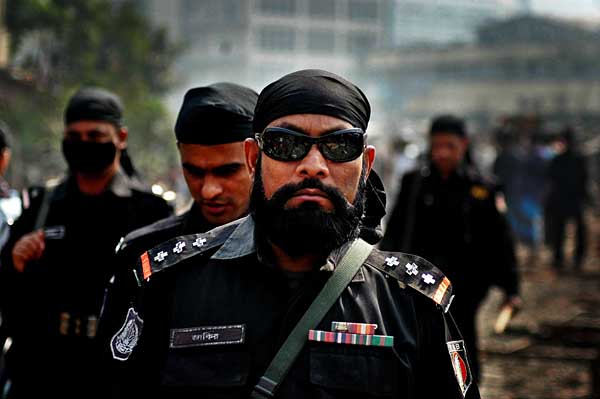
The government should disband the paramilitary Rapid Action Battalion (RAB), Human Rights Watch said Monday.
In a letter to Prime Minister Sheikh Hasina, it said that until the RAB was disbanded, it should be made an entirely civilian force by withdrawing all military officers and soldiers from its membership.
 Evidence that RAB officers were responsible for the contract killings of seven men in April, allegedly on behalf of a ruling party member, have provoked outrage in Bangladesh and are yet another example of how the unit has operated as a deat...
 Evidence that RAB officers were responsible for the contract killings of seven men in April, allegedly on behalf of a ruling party member, have provoked outrage in Bangladesh and are yet another example of how the unit has operated as a deat...
Chevron wants new area at Bibiyana without tender

US oil firm Chevron Bangladesh placed an unsolicited proposal to the government to expand its operational area by 67 square kiliometres, under onshore block 12 at Bibiyana gas field, officials said.
Chevron demanded the extended area which its predecessor Unocal relinquished after the discovery of Bibiyana gas field in 1998, they said, reports the New Age.
 Petrobangla, the state-run Oil, Gas and Mineral Resources Corporation, owns the area.
‘Under normal circumstances, Chevron will have to bid for oil and gas exploration in the area...
Petrobangla, the state-run Oil, Gas and Mineral Resources Corporation, owns the area.
‘Under normal circumstances, Chevron will have to bid for oil and gas exploration in the area...
 Petrobangla, the state-run Oil, Gas and Mineral Resources Corporation, owns the area.
‘Under normal circumstances, Chevron will have to bid for oil and gas exploration in the area...
Petrobangla, the state-run Oil, Gas and Mineral Resources Corporation, owns the area.
‘Under normal circumstances, Chevron will have to bid for oil and gas exploration in the area...
Capacity building stressed to face climate challenges in aquaculture

Fisheries experts at a workshop here have stressed the need for building institutional capacity to address the growing challenges of the country’s aquaculture sector induced by climate change.
They said the increased incidences of extreme climate events like flood, drought and storm will affect the safety and efficiency of fishing operations in the future and increase damages to coastal and riparian homes, services and infrastructure affecting the aquaculture sector.
Fisheries and Livestock Minister Muhammed Sayedul Hoque inaugurated the workshop, reports UNB.