Guide to Dhaka: ‘an unplanned sprawl’

My name is Ershad Ahmed. I retired in 1994 after spending 27 years working in government. I started my photo blog, Dhakadailyphoto, eight years ago. I have been living in Eskaton, a residential neighbourhood in Dhaka, for 20 years. It intersects a stretch of the VIP road that connects two landmarks of Bangladesh’s capital: the Shahbag Square and the Pan Pacific Sonargaon Hotel.
People in the neighbourhood are friendly and cooperative. A lot of businesses have moved here recently, taking advantage of its central location. During the World Cup, locals supported the two South American soccer giants, Brazil and Argentina: their flags fluttered in most houses throughout the tournament.
![]()
Inside Bangladesh’s cheap cigarette factories
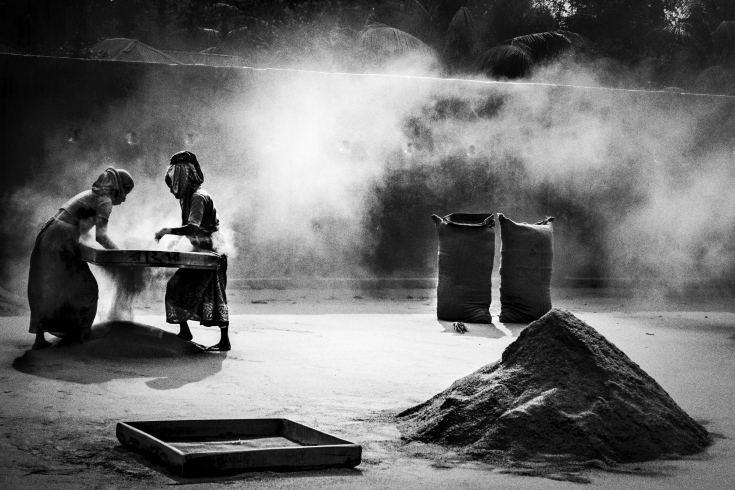
About a year after Sayed Asif Mahmud began hanging around Bangladesh’s bidi factories to document those who make the hand-rolled cigarettes with low-grade tobacco, a cheap and popular alternative for pre-packaged ones across southeast Asia, he stopped. “I’m always in a dilemma with whether I’m the right person to tell someone else’s story,” he tells TIME. “Why am I doing this? For me or for them?”
[caption id="attachment_8250" align="alignleft" width="300"] Two women remove dust from thrashed tobacco in a factory. Rangpur, February 2008.[/caption]
That was in late 2008, as he was finishing h...
Two women remove dust from thrashed tobacco in a factory. Rangpur, February 2008.[/caption]
That was in late 2008, as he was finishing h...
Two women remove dust from thrashed tobacco in a factory. Rangpur, February 2008.[/caption]
That was in late 2008, as he was finishing h...
Bangladesh: In pursuit of freedom

Kerry Kennedy
People love freedom so much that they have withstood great armies, famine and intractable poverty. Visiting Bangladesh has been a lifelong dream of mine, but all that I had heard about a people who love freedom so much that they have withstood great armies, famine and intractable poverty could not prepare me for what I’ve seen in the last three days. The Bengali patriots’ courage and endurance in the face of the Pakistani army forty years ago is the stuff of legend in our family...
Uneasy alliance reveals complex social issues

Bangladesh might be better known for natural disasters and human suffering, but for years this south Asian nation has been a kind of Silicon Valley in the field of social entrepreneurship and anti-poverty programs.
It is the birthplace of BRAC, the world’s largest non-government organization that’s helping survivors of the 2013 Bangladesh factory collapse, and Grameen Bank, better known in the West since winning the 2006 Nobel Peace Prize.
However, the success of Grameen and BRAC is still dwarfed by the sheer scale the economic and environmental problems faced by this crowded, low-lying nation of 150 million. So the challenge for behemoths and start ups alike is to scale up — not just to have a wider social impact but also to sustain the enterprise so it depends less on charity.
...
Steady pursuit of justice and freedom in Bangladesh

Last week, at the invitation of my friend Muhammad Yunus, I traveled to Bangladesh, a truly humbling and inspiring experience. I met so many incredible people struggling to improve their country and their lives. I wrote a letter to my daughters about my travels, which follows:
Dear Cara, Mariah and Michaela,
[caption id="attachment_7748" align="alignleft" width="300"] Kerry Kennedy, President of the Robert F. Kennedy Center (third from right), with Grameen Bank members.[/caption]
...
Kerry Kennedy, President of the Robert F. Kennedy Center (third from right), with Grameen Bank members.[/caption]
...
 Kerry Kennedy, President of the Robert F. Kennedy Center (third from right), with Grameen Bank members.[/caption]
...
Kerry Kennedy, President of the Robert F. Kennedy Center (third from right), with Grameen Bank members.[/caption]
...
Capitalist solution for a capitalist failure

In April 2013, a horrendous collapse of a rickety garment factory in Bangladesh killed more than 1,100 workers. The year before, fire swept through another, killing 117 people, and despite such tragedies, improvements in that country’s garment sector have been few and far between.
 The reality is that capitalism and globalization have given Western consumers cheap goods and helped emerging economies grow, but that’s usually done through the exploitation of workers and the environment. Shop floor co...
 The reality is that capitalism and globalization have given Western consumers cheap goods and helped emerging economies grow, but that’s usually done through the exploitation of workers and the environment. Shop floor co...